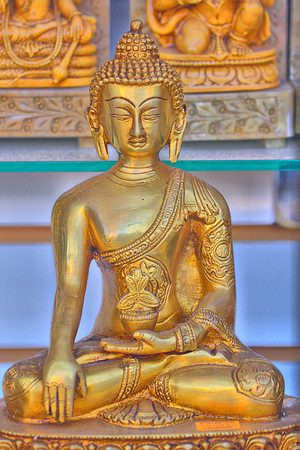
Medicine Buddha
Ancient teachings tell us that merely seeing the Medicine Buddha, oreven seeing an image of the Medicine Buddha, or hearing the name of theMedicine Buddha, can confer inconceivable benefits.
In Tibetan images of the Medicine Buddha the left hand typically holds a blooming myrobalan plant. Tibetan medicine recognizes three basic types of illness, the root causes of which are the conflicting emotions --passion, aggression, and ignorance. Myrobalan is the only herb in the Tibetan pharmacopoeia that can aid in healing each of these three types of diseases. This is like the action of the Buddha of Healing, who has the power to see the true cause of any affliction, whether spiritual,physical or psychological, and who does whatever is necessary to alleviate it.
"His right hand is extended, palm outward, overhis right knee in the gesture called supreme generosity. In it he holdsthe arura, or myrobalan, fruit. This plant represents all the bestmedicines. The position of his right hand and the arura which he holdsrepresent the eradication of suffering, especially the suffering ofsickness, using the means of relative truth. Sickness can be alleviatedby adjusting the functioning of interdependent causes and conditions bythe use of relative means within the realm of relative truth, such asmedical treatment and so on. The giving of these methods is representedby the gesture of the Medicine Buddha's right hand.
"His lefthand rests in his lap, palm upward, in the gesture of meditativestability or meditation, which represents the eradication of sicknessand suffering— and, indeed, the very roots of samsara— through therealization of absolute truth. From the point of view of eitherrelative truth or absolute truth, the fundamental cause of sickness andsuffering is a lack of contentment and the addictive quality ofsamsara. Therefore, to indicate the need for contentment, in his lefthand he holds a begging bowl."